Get More Business
Reach more of the right customers, answer them faster, and keep the ones you win.
Start here if inquiries slip through, leads stall before they close, or good customers drift away without anyone noticing.
See the Lane 1 Tracks

AI advisory for established businesses
Most AI pitches promise more customers. That is half the opportunity. The other half is already inside your building: hours lost to manual work, answers stuck in a few people’s heads, and numbers you see a month too late. AI Means Business helps you decide where AI fits in both, and where it does not.
Take AIM before you spend another dollar on AI.
For owners and operators of businesses with roughly 10 to 200 employees. Based in Colorado Springs, working nationwide.
Assess
Inquire
Map
In short
AI Means Business helps established companies decide where artificial intelligence belongs in their existing workflows, using a three-step method called AIM: how the business really runs, with the questions that separate opportunity from hype, and a ranked plan for what to improve first. The work runs in two lanes: getting more business (customer communication, marketing, follow-up) and getting more out of the business you already have (operations, internal knowledge, and real-time reporting for better-informed decisions). Clients work either lane or both. It is independent, vendor-neutral, and priced with fixed fees agreed up front.
Two lanes, one range
Getting more business is the lane everyone is selling. Getting more out of the business you already run is the lane most owners never hear about, and it is often where the quickest, lowest-risk return is sitting. The lanes are not either-or. You can work one, the other, or both, and the AIM Assessment tells you where to start.
Reach more of the right customers, answer them faster, and keep the ones you win.
Start here if inquiries slip through, leads stall before they close, or good customers drift away without anyone noticing.
See the Lane 1 TracksRun the business you already have with less friction and better information: smoother operations, know-how that stays in the building, and numbers you can act on today instead of next month.
Start here if work gets typed twice, the same questions eat your best people's time, or it takes days to pull together a report you need every week.
See the Lane 2 TracksEither lane, or both. Same method, same fixed fees, a clear finish line on every Track.
Burned or frozen
Most of the leaders I talk to are either burned or frozen.
“We bought the tools. Not much changed.”
You paid for subscriptions, sat through demos, maybe ran a pilot. People tried it for a few weeks and drifted back to the old way. Now there is a line item on the card statement and a little less patience in the building for the next idea.
That's us“We know we should. We don’t know where.”
Competitors talk about AI, vendors call every week, and your team keeps asking. You are not against it. You just would rather not spend real money until you know what is worth doing in your business, and nobody has helped you work that out without selling you something.
That's usWhy AIM comes first
An Olympic recurve target sits 70 metres away and its face is 122 cm across. Drag the slider to see how far a tiny error at release carries by the time the arrow arrives. AI projects tend to miss the same way: not from one dramatic mistake, but from a slightly wrong start that nobody corrected.
On target
Clear problem, the right workflow, people on board.
70 m · side-to-side scale exaggerated
The method
Assess. Inquire. Map. Then release.
Notice the first two letters. AIM comes first, and the AI comes after. The method is built to slow the decision down just enough to get it right.
An honest look at how work really moves through your business today: who does what, where it piles up, and what it costs you when it does.
Better questions before answers. What problem is worth solving first, what would “better” look like, and what would have to be true for a tool to help?
A ranked, written plan: which workflow first, with which tools, how you will measure it, and what you are deliberately leaving for later.
Engagements
You always know the next step and what it costs before you take it.
That line is the whole pricing philosophy. A conversation is free. A plan is a fixed fee. Building something is a fixed fee per Track, scoped in writing before any work begins, so nobody ends up inside a project that keeps growing legs.
The AIM Assessment is never skipped. It is the step that keeps you from paying to build the wrong thing well.
My honest opinion is always free. A written plan is worth paying for. Building it right is worth more, and you’ll know the price before we start.
Free
Thirty minutes to hear how your business runs and where AI keeps coming up. You get my honest read, including when the answer is “not yet.”
Fixed fee · required
Assess, Inquire, Map, done properly for your business. You leave with a written plan that ranks the six Tracks across both lanes and says which to take first.
Fixed fee per Track
One workflow, one deliverable, one measure. A working improvement with a clear finish line instead of an open-ended project.
Optional
A short scheduled review to check the improvement is holding and decide whether, and when, the next Track makes sense.
The six Tracks
Three Tracks in each lane. Your assessment ranks all six for your business. Most clients start with one.
How customers reach you and how quickly and consistently they hear back: phones, web forms, email, chat.
How new business is found and won: one lead source, one content routine, or one quoting step that stalls.
What happens after the sale: follow-ups, reviews, renewals, reorders and the customers who quietly drift away.
How work moves inside the building: scheduling, order tracking, handoffs, paperwork that gets typed twice.
The answers that live in your best people's heads, and the hours lost asking for them.
Archers use a spotting scope to see where their arrows land without walking downrange. This Track does the same for your numbers: the reports you build by hand, pulled together automatically and kept current, so decisions run on today's data instead of last month's.
Free book
Before you spend another dollar on AI, learn to take aim. A short, honest book for leaders weighing AI. It will not tell you which tool to buy. It shows why well-run companies miss with AI, walks through Assess, Inquire and Map, and leaves you with the questions to start asking about your own operation, whether or not you ever call me.
Download the free PDF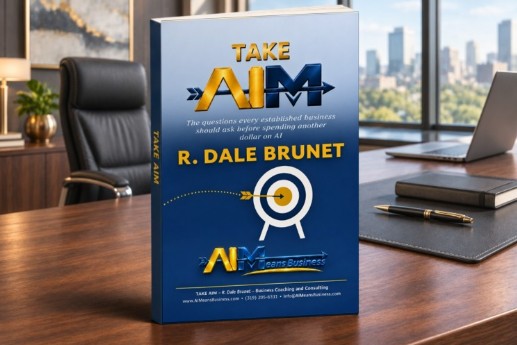

About
I have spent more than thirty years building software and information systems, inside large organizations like Unisys, Honeywell and L3 Communications and inside businesses I owned and ran myself. What I am good at is taking a complicated system and making it understandable, then finding the steps in it that a machine can carry so people do not have to.
About R. Dale BrunetMost AI help is aimed at getting more business: more leads, faster replies, better follow-up. That matters, and it is one of the two lanes I work in. The other lane is getting more out of the business you already have: smoother operations, knowledge that does not live only in a few people's heads, and reporting that shows you where things stand today so you can make better-informed decisions. The lanes are not either-or. Some clients work one, some work both, and the AIM Assessment tells you which to start in.
The AIM Method is a three-step framework for deciding where artificial intelligence belongs in your business workflows. Assess how work really moves through your operation, Inquire with questions that separate opportunity from hype, and Map a ranked plan for what to improve first. The name is deliberate: AIM comes first, and the AI comes after.
Established businesses with roughly 10 to 200 employees who want to make informed decisions about AI. Not startups looking to build AI products, and not enterprises with dedicated technology teams. Business owners and operators who run real operations and want straight answers about where AI might help.
Fixed fees agreed before work begins. A conversation is free. The AIM Assessment is a fixed fee that covers the complete Assess, Inquire, Map process. Each Track (improvement project) is a fixed fee scoped in writing before any work starts. No hourly billing, no scope creep, no surprises.
No. Anyone who guarantees specific AI results is selling you something unrealistic. What I guarantee is honesty: if I don't think AI will help your situation, I'll tell you during the free conversation. If the assessment reveals that your best opportunities don't involve AI at all, the plan will say so.
That's not what I help with. The AIM Method focuses on finding work that machines can carry so your people don't have to — not on replacing people. The goal is to free up your team to do work that requires human judgment, relationships, and expertise.
Every AI strategy starts with AIM.
Don’t just get more business. Get more out of your business.
Three minutes to see where you stand. Thirty minutes to talk it through. No pitch deck and no software to sell.